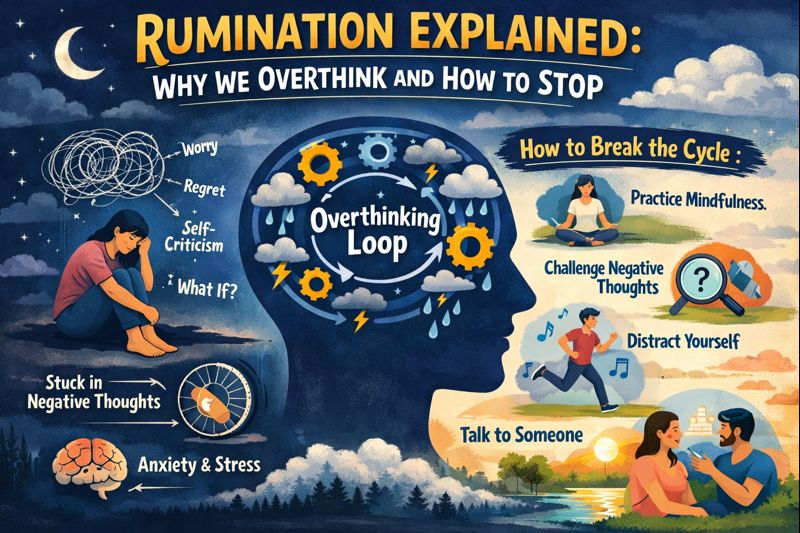
A recent UK study of more than 30,000 people showed that focusing on adverse events (particularly rumination and self-blame) can be the most significant predictor of some of today's most common mental health problems. When a negative thought arises, it tends to attract more associated distressing thoughts. When we think about harmful, fearful, or destructive thoughts, we are fuelling negative energy that persists as a memory for far longer, keeping the vicious cycle of overthinking alive. In this article, the issue of rumination and overthinking is explained through the art of mindfulness.
Relaxed Awareness
Whenever the same set of thoughts is triggered, we get involved in the same loop of overthinking. We, therefore, need to allow time to release the negative energy, and for that, we must fully face what arises in our minds. This is achieved through a simple yet very effective exercise called "relaxed awareness."
We are required to watch the mind and observe the feelings in a non-judgmental, nonreactive, and, in a sense, detached way. Just sitting in a relaxed manner and acknowledging whatever arises in the mind is all it takes. After a few moments, the negative energy, lacking its usual fuel, will begin to dissipate, and we will see the pattern of negative thoughts start to break. As we stay in this space of relaxed awareness, the intensity and frequency of negative thoughts will diminish.
It is the Monkey Mind that Overthinks
Practicing mindfulness meditation is indeed an effective way to control overthinking. Sages have often noted that the mind is like a monkey. It jumps from one group of thoughts to another, restless and sometimes even uncontrollable. On such occasions, we must exercise greater awareness in our observation of whatever thoughts are arising in consciousness.
Once we become aware that such thoughts disturb our minds, we can better identify the underlying causes of overthinking. When we do this, from that moment on, the intensity and frequency of distressing thoughts will start to decline.
Most of the time, the main problem is that we need to be made aware that we are in overthinking mode because of a strong identification with our minds. Unfortunately, we fail to realize that it is the mind that overthinks. Sometimes we get trapped in the cycle of negative thinking.
Stickiness of Thoughts
Negative and distressing thoughts tend to stick in our heads and do not go away quickly. Even if we try to divert our attention or get busy with other things, the 'stickiness of thoughts' does not allow those thoughts to loosen their grip on the mind.
We then fall into overthinking mode. We go on repeating the same set of thoughts. The frequency and intensity of those repeated thoughts will not automatically decrease.
The Art of Mindfulness
We can, however, break this cycle through awareness. If we only become aware of the negative thoughts we repeat and that make up our inner voice, we can limit their recurrence. The best way to overcome overthinking is to learn the art of mindfulness. Our mind oscillates from pure awareness to complete mindlessness or absent-mindedness. We experience the highest state of attention when we focus on the moments at hand. This state is known as mindfulness.
We often become mindless, impulsive, and reactive when we are not mindful. We become prone to missing valuable experiences because, in a sense, we are not awake during those times. As a result, we are unable to exercise complete control over our inner world, i.e., our mind.
Mindfulness Based Meditation
Surprisingly, there is a very simple mental exercise we can use to learn and cultivate mindfulness. This mental exercise is meditation. When we are mindful, conscious, and fully awake, we can effectively control the tendency to overthink. We invariably overthink when we are not in the present moment.
Mindfulness-based meditation is currently one of the most potent wellness trends worldwide. It is growing exponentially across many nations, including the USA and India. Since scientific studies have validated the benefits of meditation globally, many people have started adopting this practice.
In many countries, like the USA, the mindfulness movement has grown as more people have realized its potential for their physical and mental well-being. Hopefully, India will also witness such an awareness movement about mindfulness.
Take Away
Excessive contemplation can be detrimental to our mental well-being. It can lead to mental health conditions including anxiety and depression and negatively impact our relationships. Nonetheless, there are methods and strategies to manage overthinking and promote mental health, including self-care, mindfulness, relaxed awareness exercises, and asking close friends and family for support.
By incorporating these strategies into daily life, it is easier to reduce the consequences of overthinking and attain a more balanced and focused outlook on life.