
The human need for faith and God
As long as humans are insecure, vulnerable, and living without some kind of faith, they will continue to
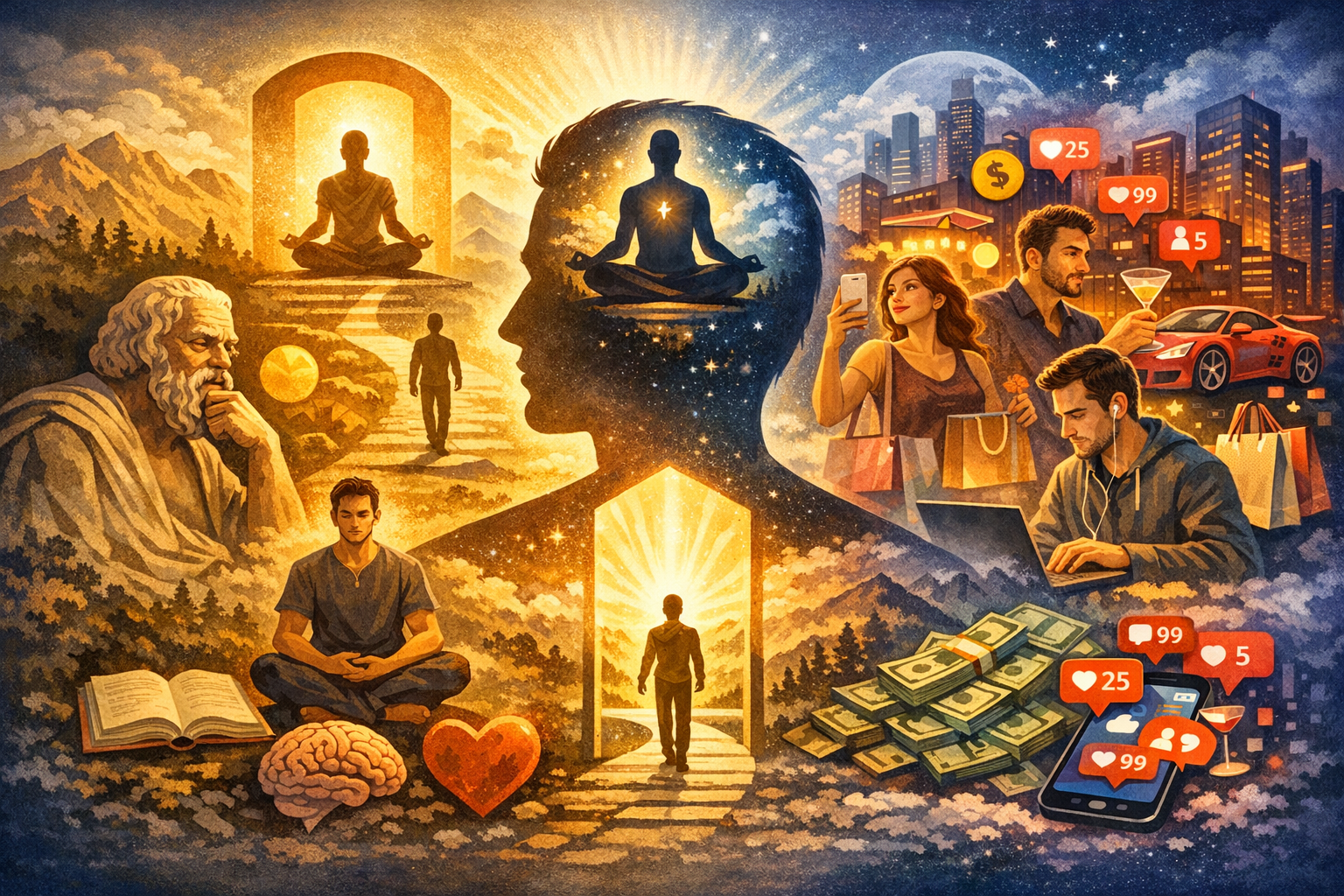
need God. Not only are we hardwired for God, but He is very much there in our collective psyche. This is also why faith becomes more than a belief system for many people it becomes a powerful emotional and psychological support system. In moments of stress, uncertainty, grief, or loneliness, belief can offer stability, hope, and inner strength that protects mental wellbeing.
Ideas about God have successfully survived for hundreds of thousands of years as man evolved from
hunter-gatherers to the complex being that he is today. Even scientists who seek and find answers to
many questions, such as -- What was there before the Big Bang? What is the nature of dark energy
and dark matter? What exactly is consciousness, and how did we become conscious? What is beyond the horizon of this universe? -- Often evokes some sort of mysterious entity or pervading
consciousness that constitutes and governs all.
Why ideas about God have survived across human evolution
Numerous concepts and hypotheses have been proposed by philosophers, religious scholars, and
other thought leaders that reinforce our faith in God's existence. From St. Thomas Aquinas’s Five
Proofs, to ontological arguments, to the anthropic principle and the theory of intelligent design, we
have much to ponder. However, this question will remain unsolved in the absence of any conclusive or empirical proof. In any case, each one of us has their own ideas about God, which are unique and
personal. Given the unknowable attributes of God, everyone’s ideas are highly diverse. In any case,
the primary advantage of believing in the existence of God is consolation and the reassurance we
continue to derive from the faith. I believe that is why most of us need God.
Even science often points to something beyond
For many, there is a personal God who very minutely oversees their lives. He makes elaborate plans
for each life. He writes our destiny before we come into this world. We will get punished or rewarded
according to our deeds in this generation or perhaps in our next incarnation. There is a famous and
relevant quote by George Carlin, an American author, that goes like this: “Religion has convinced
people that there is an invisible man – living in the sky – who watches everything you do, every minute of every day. And the invisible man has a special list of ten things he does not want you to do. And if you do any of these ten things, he has a special place, full of fire and smoke and burning and torture and anguish, where he will send you to live and suffer and burn and choke and scream and cry forever and ever till the end of time …. But he loves you! “
Philosophical arguments that reinforce belief
For some, there is a God who does not interfere in the lives of everyone. He has broader plans for
humanity. Why do we need God in this modern age of science, reason, and rationality? For one thing, just about everyone needs psychological and emotional support. Life is not without experiencing uncertainties, sorrows, and tragedies. No one can escape such eventualities. At the most trying times,we seek God's support. We can justify deaths and other losses by believing that this is God’s Will, or part of His greater plan, or maybe for a greater good. We get solace from such beliefs, attributing ultimate love and wisdom to God.
Experiencing a Heavenly Father helps millions of people bear, and sometimes overcome, tragic or
simply difficult experiences. Without such support, misfortunes and any personal challenge can be far
more painful. Therefore, the eternal being and presence of God are required for humanity to fill the
gaps when no other comfort or explanation is available.
The idea of a personal God
During our life’s journey, when we face situations that leave us feeling uncertain, insecure, fearful, and
vulnerable, we need God. He is believed to be all-powerful, all-loving, and sensitive to our needs.
Many find that God also responds to their prayers and the rituals they perform to seek His blessings.
Occasionally, God also bypasses the laws of nature by performing miracles or supernatural events,
some of which become fodder for myth and folklore. This is what we call a religious or personal God.
God of Science
A very large segment of religious individuals believes in a personal God. However, there is also
widespread belief in a God of Science. Here, God is seen as the cosmic intelligence behind order,
harmony, and complexity, beyond human capacity to comprehend. God has created an intelligent,
conscious, and self-organising universe. Modern science has, in large part, embraced the God of
Science.
Pascal's wager argument
Despite (and sometimes because of) scientific and technological advances across almost all areas of
life, it appears that even the most literate populations still believe in God. Many of us simply feel safer
and more secure believing in God’s presence rather than denying and rejecting that which might be the Ultimate Reality. There is a popular philosophical argument called Pascal's wager that asserts that it is wise to believe in God, even if God's existence cannot be proved or disproved through reason, and even if it turns out to be false.
Blaise Pascal Theory on God
This argument was presented by seventeenth-century French philosopher, mathematician, and
physicist, Blaise Pascal (1623–1662). According to his thinking, if we wager that God does not exist,
and there is indeed no God, then it does not matter. There is no point in even making a wager. If,
however, there is a God and we deny His existence, then we risk God’s wrath and may be sent to hell
after death. The most felicitous outcome, of course, would be that God does exist and we believed it
right along, in which case our reward would be eternal, unlimited happiness. Therefore, it’s better to
believe in His existence even if there is no God: The unbeliever has nothing to gain and perhaps
everything to lose, whereas the believer may have everything to gain and nothing to lose. Many peopletend to remain neutral even if they have serious doubts about God’s existence.
The problem of theodicy
There is another very relevant question that usually arises when we talk about God. It’s that if God is
so powerful, benevolent, and all-loving, then why does He permit people to commit cruelty and crimes
against their fellow beings? Sometimes the intensity of the cruelty is beyond our imagination, and on
those occasions, this question invariably comes to the mind of theists. This problem is also called
“theodicy.” Theodicy is a theological construct that attempts to vindicate God in response to the
fundamental problem of evil in all its expressions.
Evilness and Go
Many perspectives and philosophical approaches have addressed this issue. Two dominant responses prevail. First, God permits evil to facilitate a greater good. Without cruelty and evil, it would be impossible to fully appreciate virtues such as compassion and love. Second, by granting humans free will, God allows evil as its natural consequence. By considering both arguments, we can better
understand different perspectives on the existence of evil.
As an inevitable result of human freedom, evil motivates humans to grow and evolve; God, therefore,
allows it as the price of freedom/free will. However, many don’t accept this argument because there are occasions when human atrocities and even devastating acts of nature seemingly cannot be justified as a cost of freedom. At the same time, many feel that this world of good and evil is a perfectly conducive and enabling environment for growth and development. Amidst infinite possibilities for good and evil, humans may evolve toward that for which they were “created” by God.
To conclude
In any case, people feel safe and secure in believing in God, whether or not God exists. It’s better not
to reject or deny God, especially when people are subject to uncertainties and the inherent vulnerability of life. Any situation can be explained by the existence of God. In times of trouble, God provides emotional and psychological support.
There are studies that support the relationship between belief in God or a higher power and mental
health treatment. People who believe in God respond better to treatment for depression than those
who do not. Even in loneliness, God can be a great source of psychological support. Some studies
have also established the tonic link between faith or belief in a Higher Power and psychological well-
being. Many of us would do well to turn to God for support and guidance.