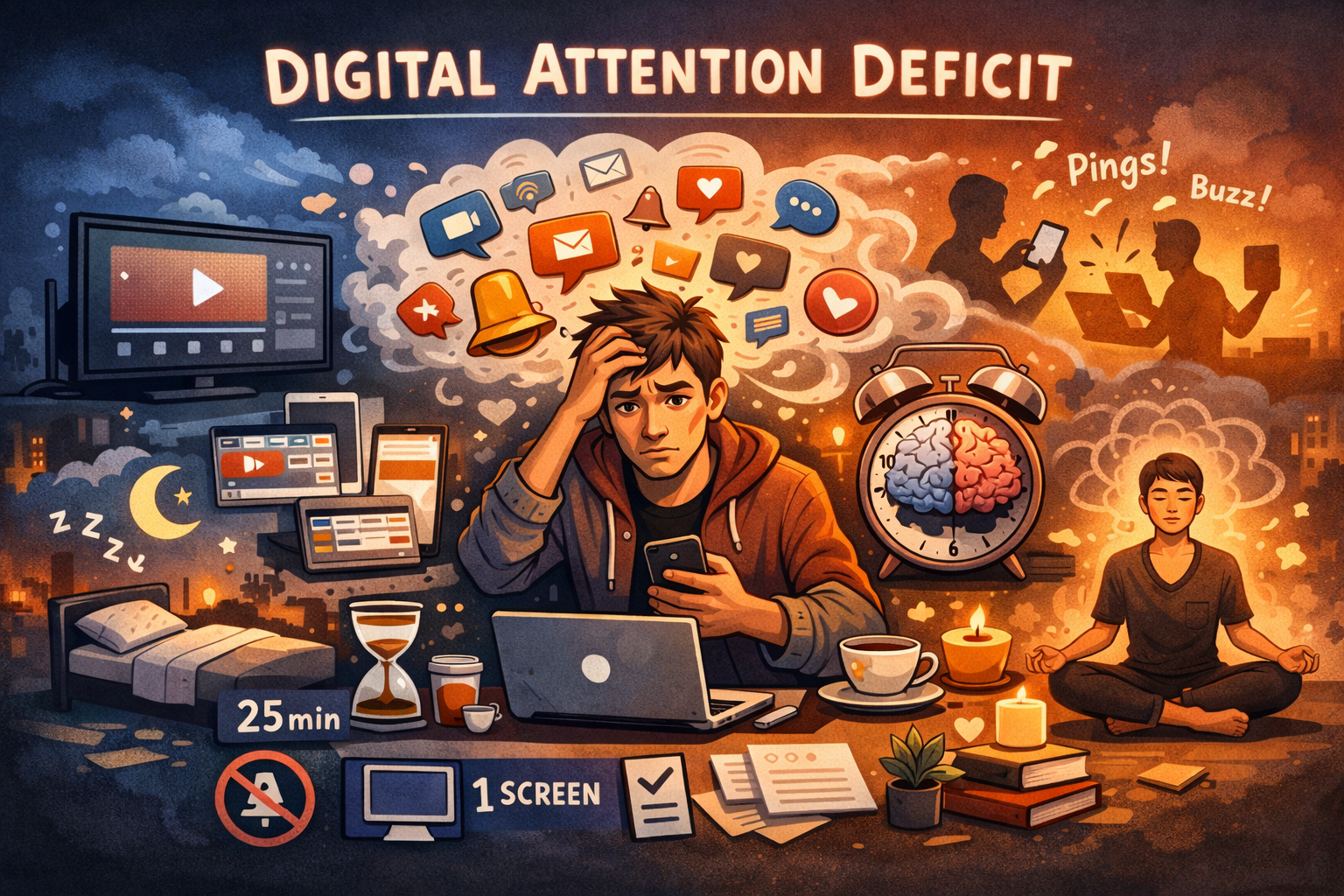
We try to relax with one screen, but soon we get caught with another. A video plays, messages appear, and our thumb scrolls almost on its own. It is all automatic, hands and fingers move instantly. When we stop, we do not feel rested, we feel distracted and scattered. Many of us quietly ask, "Why can't I focus like I used to?"
This is the everyday attention deficit of the digital world. It is not a label or a diagnosis, but a real feeling—our attention pulled in many directions, making it hard to focus on just one thing.
The digital world is designed to compete for our attention.
The numbers are huge. Around the world, people spend about 400 minutes online each day, or 6 hours and 40 minutes (DataReportal – Global Digital Insights). In India, the internet is part of daily life for almost everyone. Reuters says there are nearly 1.02 billion internet users and about 750 million smartphones, with people in India spending an average of 3.2 hours a day on social media apps (Reuters).
When everything around us is made to grab our attention, it becomes a limited resource. It's not that we are weak, we are just exposed.
What "attention deficit" looks like in daily life
In the digital world, attention deficit often looks like:
The "second screen" habit
We watch, scroll, reply, and switch between tasks all at once. It feels normal, but our brain sees it as nonstop switching. Then, restart, and repeat. Even fun things begin to feel like work.
Brain fog and mental fatigue
It's not that we did too much meaningful work—it is that we switched tasks too often.
The hidden cost: switching isn't free
Our brain pays a tax every time we shift tasks. Classic task-switching research shows that there are measurable "switch costs" in speed and accuracy when we switch between tasks. (American Psychological Association)
And interruptions do not just take a moment—they take away our momentum. UC Irvine research shows it can take up to 25 minutes to get back on track after being interrupted. So, a day full of pings and checks can quietly ruin our ability to do deep, satisfying work," says about multitasking and distraction.
One well-known study on media multitasking found that heavy media multitaskers were more vulnerable to distraction, getting pulled by irrelevant information more easily than light multitaskers.
Stanford's coverage of that research captured it in a line that stuck with many people. Clifford Nass said heavy multitaskers are "suckers for irrelevancy," meaning everything distracts them. It is blunt, but it points to something important: the more we train our minds on constant switching, the harder it can become to filter noise.
Why does it feel so hard to stop
Many platforms use variable rewards. Sometimes we see something exciting, sometimes we do not, so we keep checking. Over time, this habit becomes automatic.
Anxiety and "just in case" check. We do not just check for fun. We also check because we are afraid of missing out, and about latest news, work, wellbeing of our family, or feeling disconnected.
Shared culture of urgency
When everyone is always reachable, we feel pressure to respond fast, even if it hurts our focus.
What we can do: rebuild attention without quitting the internet
We don't need a perfect digital life. What we need is a kinder, more intentional one.
1) Make one screen the rule
If we are watching something, make that the only screen. If we are scrolling, do not try to relax with a show at the same time. This one change cuts down on switching.
2) Turn off non-essential notifications.
Most alerts are not emergencies; they are just invitations. When we cut down on notifications, we lower the "attention tax."
3) Create focus pockets
Try working on one task for 25 minutes, then take a 5-minute break. Keep your phone out of reach during those 25 minutes. Even small daily focus sessions can help rebuild your confidence.
4) Use a "start ritual" for deep work
Take a deep breath, set a clear intention, and keep just one tab open. Simple rituals like these tell your brain, "Now we stay."
5) Protect sleep and rest.
When we are tired, it is harder to control ourselves and we crave quick rewards. So, attention is not just about willpower, it is also about managing our energy.
A gentle closing thought
Our attention is not just for getting things done, it shapes how we experience life. The digital world will always demand it, but we can choose to set small boundaries and return to ourselves. When we do, we get back something valuable: calm, clarity, and the sense of being truly present in our day.