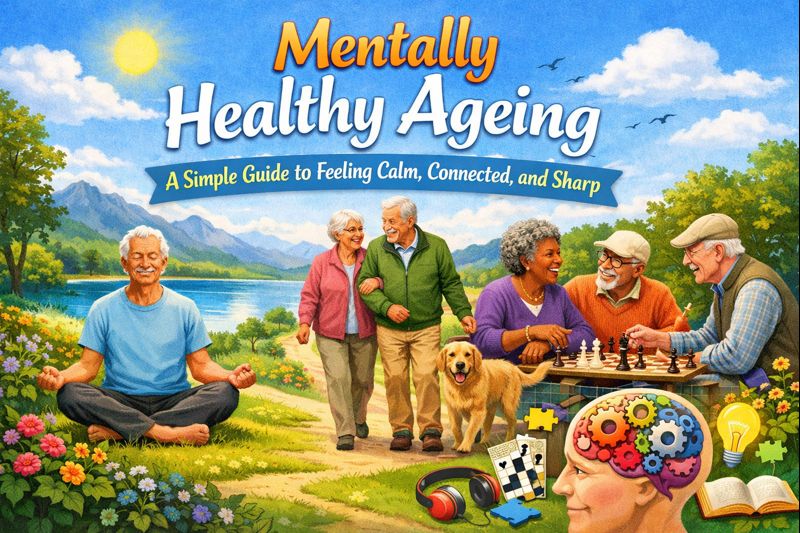
Imagine a scenario of a typical evening: the TV is on, the phone is quiet, but thoughts keep racing. Many elders say life looks fine on the outside, but inside, it can feel empty. Children are busy with their own lives, often living abroad and visiting only once or twice a year. After losing a spouse, some elders find themselves living with memories. They want to stay active, but their bodies do not cooperate as before. Many are so used to their routines that they hesitate to step out of their comfort zones. In India, where family and community support used to be a given, this change can feel quietly overwhelming.
Once we understand what many elders go through, it is important to remember that positive change is possible. Good mental health in old age is not just luck. We build it slowly, with small choices each day.
The long-running Harvard Study of Adult Development says it best: "The key to healthy aging is relationships, relationships, relationships." Not money or status, but relationships.
Positive ageing does not mean acting strong all the time.
Positive ageing is not about forcing ourselves to be cheerful. It is about accepting losses and choosing habits that support our mood, dignity, and sense of purpose.
Think of positive ageing as four needs: Purpose — a reason to get up every morning; You can think of positive ageing as meeting four needs: Purpose, which gives us a reason to get up each day; People, for daily connection; Movement, to keep us energized; and Peace, for a few minutes of calmness with homework, volunteering, or watering plants. Scale does not matter; consistency does.
As Viktor Frankl said, "Those who have a 'why' to live, can bear almost any how." (Often attributed to Frankl.) For many elders, this 'why' can be family, faith, service, learning, or finding inner peace.
Loneliness is common, and it affects health
Feeling lonely is not a personal weakness. It is a natural sign that we need connection. A national study in India found that about 10% of older adults experience loneliness. Even if this number seems small, the feeling can be very heavy. Loneliness can appear as irritability, trouble sleeping, low appetite, body aches, or a sense of not feeling like yourself.
Many research studies show that loneliness and social isolation are linked with a higher risk of early death. A famous meta-analysis conducted by Holt-Lunstad and colleagues found that social isolation and loneliness are associated with increased mortality risk.
So, what can we do to handle these modern-day maladies?
Simple social connections that work in Indian context
Try at least one daily call: chose one person and talk to him/her for at least three minutes every day.
Plan a regular weekly outing, like visiting the temple, gurudwara etc on Sunday, going to the neighbourhood library, community hall, attending a laughter club or senior group get together or simply walking in the park with others.
Micro friendships: the security guard, the sabzi vendor, the pharmacist, the neighbour on the stairs. These small bonds protect the mind and keep it active. Chat even small things.
Give as well as receive: advising a younger person, teaching a skill, or helping at community events can bring respect and a sense of purpose.
We can gently remind elders: "Loneliness is not the absence of people; it is the absence of feeling seen."
Dementia and Alzheimer's: what we can prevent and what we can slow down
It is normal, off and on, to forget names, especially when we are under severe pressure, chronically stressed or have not slept well. But many families worry about dementia and Alzheimer's, and this worry can become a burden on its own.
The Lancet Commission on dementia prevention estimates that many cases of dementia can be prevented or delayed by the risks caused by lifestyle. In 2024, this number is about 45%.
The World Health Organization has also published evidence-based study on lowering the risk of cognitive decline and dementia through healthy lifestyle choices.
What we can start doing at home:
1. Be active by moving our body: We should walk on most of the days, whether it is a morning walk or the evening one. Even when at home, we should continue to move our body after every half an hour to an hour. Try to include light strength exercises twice a week, like sit-to-stand, wall push-ups, or using light weights exercises. This helps our mood and keeps blood flowing to the brain.
2. Keep blood pressure, sugar, and cholesterol under control. This is just as important for the brain as it is for the heart, especially in India, where diabetes and high blood pressure are becoming very common. Get the blood tests done at regular interval, at least after every 6 months to monitor sugar, cholesterol and triglyceride levels.
3. Sleep is the real 'brain medicine': Sleep is very crucial for the brain. We need to keep a regular sleep schedule, try to get some morning sunlight, avoid caffeine especially after lunch, and have a relaxation routine before bed. These habits surely help our memory and mood. The studies have showed that certain types of cognitive training can improve targeted thinking skills, with effects that persist for years in follow-up studies.
4. Learn and enjoy kirtan or bhajan, try to learn and practice a recipe, learn a language, do puzzles like sudoku. After retirement or on the onset of old age, we should start something new, which we never tried earlier. There are many doable skills, which can be learnt and experienced for spending time in a meaningful way.
5. Eat for your brain, in an Indian way: Studies show that Mediterranean-style eating is linked to better brain health. We can follow this idea in Indian meals by eating more vegetables, dals, sprouts, nuts, and fruits, and cutting down on ultra-processed foods and extra sugar.
Research on the MIND diet also suggests that certain eating habits are linked to slower cognitive decline, though diet alone is not a guarantee and results can vary from person to person.
How AI can help support elders' mental well-being in India
AI cannot replace family or friends, but it can be a helpful tool, especially for elders who live alone.
Healthy ways to use AI in daily life:
- Set daily reminders for medicines, drinking water, walks, and appointments.
- Use voice assistants in Hindi or other regional languages to play music, bhajans, news, or to call family members.
- Try guided breathing exercises, meditation, or listening to sleep stories.
- Use simple mood journaling prompts, write gratitude notes, or track your habits.
- Tele-consult support and symptom note that can be shared with a doctor
How to use AI safely
We should need to keep our private information safe. Cybercrimes including digital arrests are sharply increasing in India. Elderly people are very vulnerable to such crimes. We should never share passwords, OTPs, etc with anyone outside family.
Elders must remember one rule: if something sounds urgent or threatening, pause and call a family member. Try to use AI to connect with people, not as a replacement. Let it help you plan calls, join groups, and stay involved. We need to remember a quote, "Technology should reduce loneliness, not replace love."
A final thought
Ageing can be beautiful when we feel connected, useful, and at peace. We do not need a perfect routine—just small habits that help our minds feel safe and give us meaning.
If we make one connection each day, move a little, keep learning, and treat our thoughts kindly, we can age with steadiness. We can also remind every elder in our lives, with warmth, that they are still needed, still capable, and still growing.