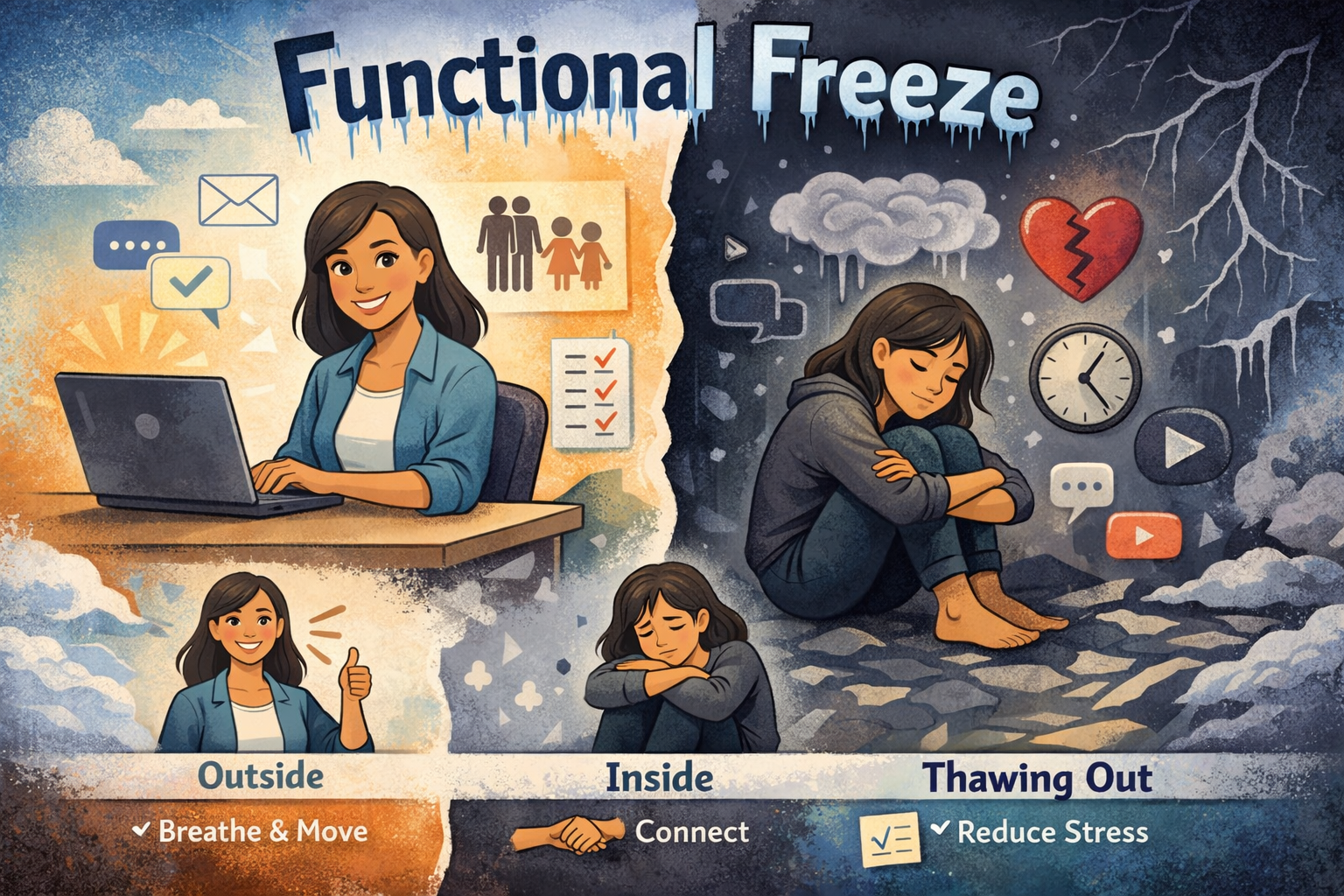

The Habit of Emotional Avoidance
We live in a world that teaches us how to do everything. How to be motivated, work hard, succeed in life, and be busy, what about how to feel? When we feel agitated or sad or distressed, we reach to our mobiles and start scrolling through our mobiles. When anxiety rises, we try to distract ourselves with work or entertainment. Somewhere, we forgot how to sit quietly with our emotions, spend time in solitude.
No doubt, these kinds of distractions or avoidance does not make our mental pain disappear. In fact, it goes deeper. Psychologists call this condition as 'emotional suppression.' The research shows it often leads to higher stress, anxiety, and even physical illness. A Harvard Health Review (2019) article explained that unacknowledged emotions can resurface as tension, fatigue, and chronic stress symptoms.
To truly heal, we must learn to stop running and start feeling. As Carl Jung, a Swiss psychiatrist and psychotherapist noted famously, "What we resist, persists."
Why We Run Away from Our Feelings
Most of us have never been taught, how to face emotions. Since our childhood, we have been hearing phrases like "Do not cry," "Be strong," or "It is nothing." Without realizing it, we grew up believing that expressing emotions are the sign of weaknesses, which are to be fixed rather than suppressing or avoiding them.
We need to understand that emotions are not our enemies. These are signals. Fear tells us we need safety. Sadness invites us to let go. Anger often points to unmet needs or boundaries crossed. When we ignore these signals, we disconnect from our own wisdom.
A study in Frontiers in Psychology (2020) found that people who practice emotional awareness, i.e. acknowledging rather than avoiding feelings, experience lower levels of depression and anxiety, besides higher emotional resilience. Simply put, the more we allow ourselves to feel, the more we heal.
The Science of Sitting with Emotions
Neuroscience gives us fascinating insight into why "sitting with" emotions work. When we experience strong emotions, the amygdala, the brain's alarm centre, activates. But when we observe those emotions with awareness, another part of the brain, the prefrontal cortex, steps in to calm the storm.
Dr. Daniel Siegel, a clinical professor of psychiatry at UCLA, describes this process as "naming it to tame it." In other words, when we acknowledge what we feel ("I'm angry," "I am afraid," "I feel hurt"), we regulate the emotion rather than being consumed by it.
Another research study from Harvard University (Lazar et al., 2011) also established that mindfulness practices, especially mindful observation of emotions, can physically reshape brain regions that are associated with emotional regulation, empathy, and self-awareness. The science is clear: awareness does not amplify pain; it transforms it.
Healing Happens in Stillness
Sitting with emotions is not easy. It takes courage to feel pain without trying to fix it straight away. But in that stillness lies profound healing. When we allow ourselves to sit with discomfort, whether it is grief, anger, or loneliness, we begin to understand that emotions are waves. They rise, peak, and eventually pass. It is our resistance that keeps them stuck.
Author and Buddhist teacher Pema Chödrön reminds us, "Nothing ever goes away until it has taught us what we need to know." The act of sitting quietly with our emotions teaches patience, compassion, and humility. It is how we befriend the parts of ourselves we once rejected.
How to Practice Sitting with Emotions
You do not need to meditate for hours or have a therapist beside you to start this practice. It begins with awareness and kindness toward yourself.
1. Pause and breathe. When an emotion arises, stop for a moment. Feel your breath. This small pause creates space between you and your reaction.
2. Name What You Feel. Silently acknowledge it: "This is sadness," or "This is fear." Naming helps the mind calm down.
3. Locate It in the Body. Emotions often appear as sensations, tightness in the chest, heaviness in the stomach, or tension in the jaw. Gently observe where it lives.
4. Stay Without Judgment. Do not label it as "good" or "bad." Just notice. Allow the emotion to unfold.
5. Reflect When Ready. Ask gently, "What is this feeling trying to tell me?" Sometimes, the message comes later—but it always comes.
Even a few minutes of this mindful awareness each day can reduce emotional reactivity and build inner strength.
The Forgotten Art of Healing
True healing does not come from avoiding pain, it comes by facing it with equanimity and understanding. Emotions are not obstacles on our path; they are guides leading us home to ourselves. When we sit with what hurts, we start to see that emotions are not permanent or dangerous—they are visitors asking to be seen and felt. Slowly, we realize that we do not need to be afraid of them.
The psychologist Susan David writes in her book Emotional Agility, "Discomfort is the price of admission to a meaningful life." Healing, then, is not about becoming perfectly calm or happy, it is about becoming whole. It is about creating space in our hearts for every feeling—joy and sorrow, fear and love, pain, and peace.
Closing Thought
In a world that tells us to "move on," "stay busy," or "get over it," the bravest thing we can do is simply pause. To feel deeply is not weakness, it is wisdom. When we learn to sit with emotions, we rediscover the calmness and quiet strength within us, the strength to stay open, to grow, and to heal.
Because sometimes, the only way out of pain is through it.
Are you looking for inner peace, deep relaxation or holistic solutions for mental health? Visit http://themindtherapy.in - your space for online counselling/therapy, free mental health tests, meditation, sound therapy etc.
Mind Therapy is India's trusted platform for mental health, mindfulness, and holistic healing. Explore expert-led programs, guided meditation, sound therapy and counselling at http://themindtherapy.in